

Description
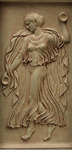
A 2026 photograph of the plaster cast of a relief depicting a Maenad. Original relief was discovered at Rome, Villa Albani.
Publication Date
1978
Type of Artwork
Relief
Time Period/Geographical Region
Ancient Greece
Height (cm/in)
139.7 cm / 55 in
Width (cm/in)
76.2 cm / 30 in
Depth (cm/in)
13.97 cm / 5.5 in
Disciplines
Ancient History, Greek and Roman through Late Antiquity | Sculpture
Recommended Citation
Morehead State University. Camden-Carroll Library., "Dancing Maenad (Relief I) - 2026" (1978). Metropolitan Museum of Art Cast Collection. 46.
https://scholarworks.moreheadstate.edu/metropolitan_art_collection/46
Comments
A Maenad is a female follower of Dionysus, the God of wine, orchards, fruit, vegetation, fertility, ritual madness, and theater. The followers of Dionysus would often be seen in a state of frenzy from imbibing too much of the God’s supply of wine! The frenzy gives the female followers their names Maenad, which translates to “mad woman.”
Unlike the Dancing Maenad Relief II in this exhibition, this relief is likely a forgery made after the Roman period. In this relief, the dancing Maenad holds a pair of cymbals to provide the rhythm for her frenzied dance. The Maenads were copied in numerous reliefs from the Classical Period of Greek art. The Romans depicted Maenads with cymbals on pottery and frescoes and in sculpture. Although the relief of this Maenad has features that were copied in Roman sculpture and fresco, there is no precedent for this relief in ancient contexts; it was likely made in the eighteenth or nineteenth centuries in imitation of the Greek and Roman originals.
Brittany Rancour, “Dancing Maenad Relief I, Metropolitan Museum of Art Cast Collection at Morehead State University,” May 2026.