

Description
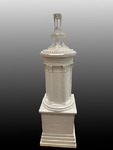
A 2026 photograph of the scale model of the Choragic Monument of Lysicrates. Origin site is Athens, Greece circa 334 BCE.
Publication Date
1978
Type of Artwork
Model
Time Period/Geographical Region
Ancient Greece
Height (cm/in)
116.84 cm / 46 in
Width (cm/in)
34.29 cm / 13.5 in
Depth (cm/in)
34.29 cm / 13.5 in
Disciplines
Ancient History, Greek and Roman through Late Antiquity | Sculpture
Recommended Citation
Morehead State University. Camden-Carroll Library., "Choragic Monument of Lysicrates - 2026" (1978). Metropolitan Museum of Art Cast Collection. 44.
https://scholarworks.moreheadstate.edu/metropolitan_art_collection/44
Comments
The Ancient Greeks celebrated victories with trophies, and those trophies would be displayed on monuments such as this. Located at the base of the Athenian Acropolis, where the Parthenon is located, is the original Choragic Monument of Lysicrates. This monument was sponsored by a man named Lysicrates who was a Choregos, or leader of the Chorus, in the Theater of Dionysus, located near the Acropolis. An inscription on the monument says Lysicrates funded this monument to celebrate a winning choral performance that he had sponsored in the competitions of 335-334 BCE.
The monument consists of a cylindrical structure on top of a square base. Surrounding the central cylinder, are Corinthian columns, the first known Corinthian columns found on the exterior of a building in Greece. The columns are identifiable by the capital on the top that is decorated with acanthus leaves. In between each column are relief depictions of tripods, three-legged bronze cauldrons awarded as trophies in various kinds of competitions.
The circular frieze above this likely depicts a scene from a Homeric Hymn to Dionysus in which the god turns the Tyrrhenian pirates into dolphins. Finally, the roof of this structure would have originally held the bronze tripod given to Lysicrates upon his victory.
It may be difficult to see these details now but keep in mind that the Greeks painted their monuments multiple colors. Bright reds or blues could have been used in the background to offer a high contrast with the sculpted reliefs.
The monument has been copied numerous times through history and has left its mark on the architecture of the United States. It served as the inspiration for Merchants’ Exchange Building in Philadelphia as well as The Soldiers’ and Sailors’ Monument in Manhattan, New York.
Brittany Rancour, “Choragic Monument of Lysicrates, Metropolitan Museum of Art Cast Collection at Morehead State University,” May 2026.