

Description
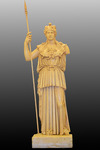
A 2026 photograph of the plaster cast of a marble statue of Athena, completed circa 1st-2nd century CE. Original housed in the Louvre. Roman copy of a 5th century BCE Greek sculpture housed in the Camden-Carroll Library at Morehead State Univeresity.
Publication Date
1978
Type of Artwork
Statue
Time Period/Geographical Region
Ancient Greece
Height (cm/in)
238.76 cm / 94 in
Width (cm/in)
88.9 cm / 35 in
Depth (cm/in)
58.42 cm / 23 in
Disciplines
Ancient History, Greek and Roman through Late Antiquity | Sculpture
Recommended Citation
Morehead State University. Camden-Carroll Library., "Athena (Minerve Au Collier) - 2026" (1978). Metropolitan Museum of Art Cast Collection. 43.
https://scholarworks.moreheadstate.edu/metropolitan_art_collection/43
Comments
This cast is modeled on an original sculpture that was made during the Classical period of Greek art and destined for installation in perhaps the most famous building in Ancient Greece: the Parthenon. The crowning glory of the temple was the 37-foot-tall chryselephantine sculpture (a sculpture made of gold and ivory) of Athena made by the famous sculptor Phidias. The sculpture was known as the Athena Parthenos, which means “Athena, Virgin”. The name Parthenon means “House of the Parthenos,” indicating the importance and fame of this sculpture in antiquity. The sculpture no longer survives; however, many ancient authors described it, and it was reproduced in small scale and life-size copies.
The Morehead cast is modeled after a Roman original copy of the Athena Parthenos now held in the Louvre in Paris. The Louvre sculpture is in the style of Athena Parthenos but represents a version dubbed the Minerve au Collier. Minerve or Minerva is the Roman name for Athena and “au collier” means necklace, referring to the lovely choker the Morehead cast wears. Draped around the shoulders and hanging over the breast is an aegis, a garment of goat skin often depicted as both a cloak and a shield, here it is covered in scales and fringed with serpents. Athena helped Perseus slay the Gorgon Medusa, and she was given Medusa’s head, which she then placed in the center of her aegis. Medusa and other gorgon faces were often included in ancient artworks as apotropaic images—images destined to ward away evil. Athena wears a peplos dress—a full-length female dress gathered and pinned at both shoulders. Athena stands in the typical contrapposto pose of Classical period sculpture, in which the weight is carried on one leg freeing the other leg from tension. The top of the helmet originally contained a central sphinx surrounded by a Pegasus on either side. The sculpture would have been completely painted in vivid colors.
Brittany Rancour, “Athena (Minerve au Collier), Metropolitan Museum of Art Cast Collection at Morehead State University,” May 2026.