

Files
Download Full Text (407 KB)
Description
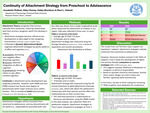
Attachment Theory recognizes that humans naturally form protective, enduring relationships with their primary caregivers which first develop in infancy.
• Attachment strategies become refined across development to best adapt to the caregiving environment (Crittenden, Landini, & Speiker, 2021).
• Crittenden’s Dynamic Maturational Model organizes attachment strategies by pecific patterns of affect and cognition (2011).
A (avoidant): dismissing own negative affect, distorting cognition
B (secure): balanced integration of affect & cognition
C (ambivalent): involving others in own affect, omitted cognition
Continuity in attachment across development was originally predicted. However, both DMM and non- DMM research has found some degree of discontinuity when major stressors occur within families. This is considered lawful discontinuity.
Publication Date
4-16-2025
Disciplines
Higher Education | Scholarship of Teaching and Learning
Recommended Citation
McNeal, Annabelle; Chaney, Abby; Blackburn, Gabby; and Kidwell, Shari L., "Continuity of Attachment Strategy from Preschool to Adolescence" (2025). 2025 Celebration of Student Scholarship - Poster Presentations. 86.
https://scholarworks.moreheadstate.edu/celebration_posters_2025/86